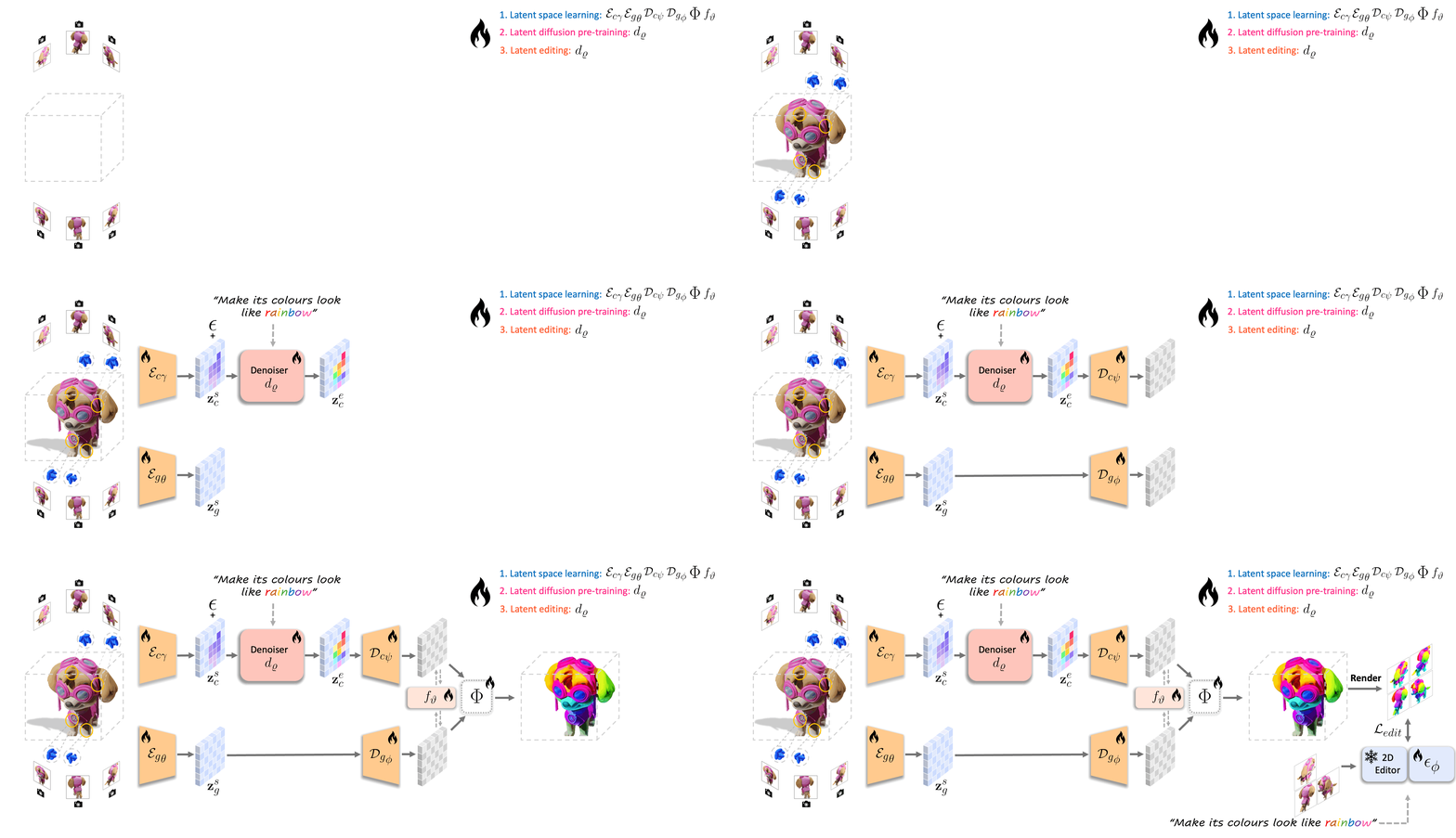
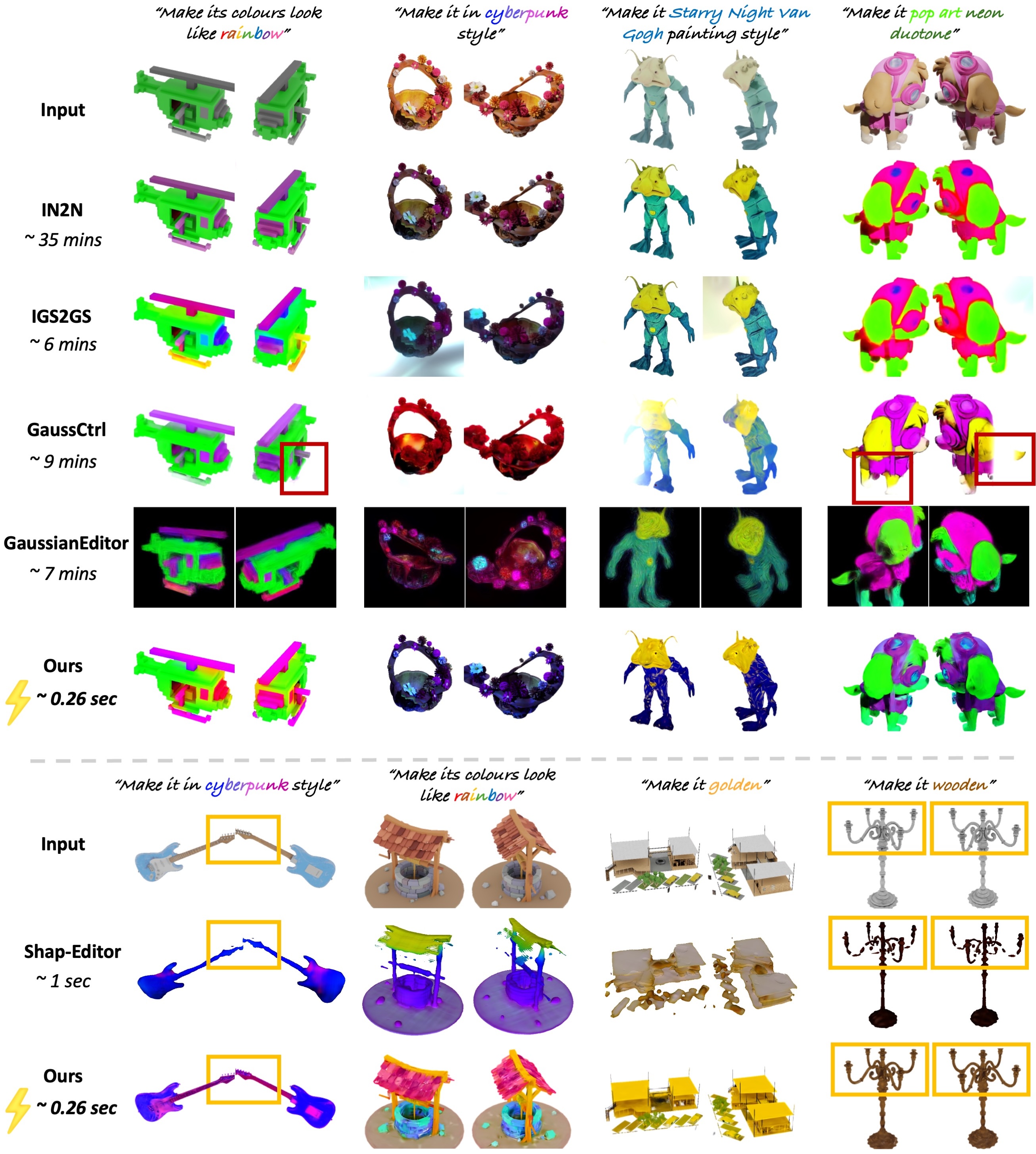
Overview of our method. (1) Latent space learning: Given input Gaussians, our method first groups them based on spatial proximity and encodes them into group-structured disentangled latent spaces, with controlled cross-branch feature sharing. (2) Latent diffusion pre-training: A denoiser learns to denoise the noisy appearance latent conditioned on a text embedding, capturing 3D appearance priors. (3) Latent editing: Once 3D priors are captured, the denoiser is adapted into an editing function that maps the input appearance latent to a modified latent, guided by the geometry latent and trained via multi-view distribution-matching distillation from a frozen 2D editor. At inference, InStyle generates high-quality, 3D-consistent stylizations from text prompts in a single feed-forward pass, fully eliminating test-time optimization. Trainable models at each stage are denoted.
Original
"Make it golden coloured."
Input Asset
"Make it in sunset palette"
Input Asset
"Make it Barbie style."
Input Asset
"Make it in cyberpunk style."
Input Asset
"Make its colours look like rainbow."
Input Asset
"Make it Starry Night Van Gogh painting style."
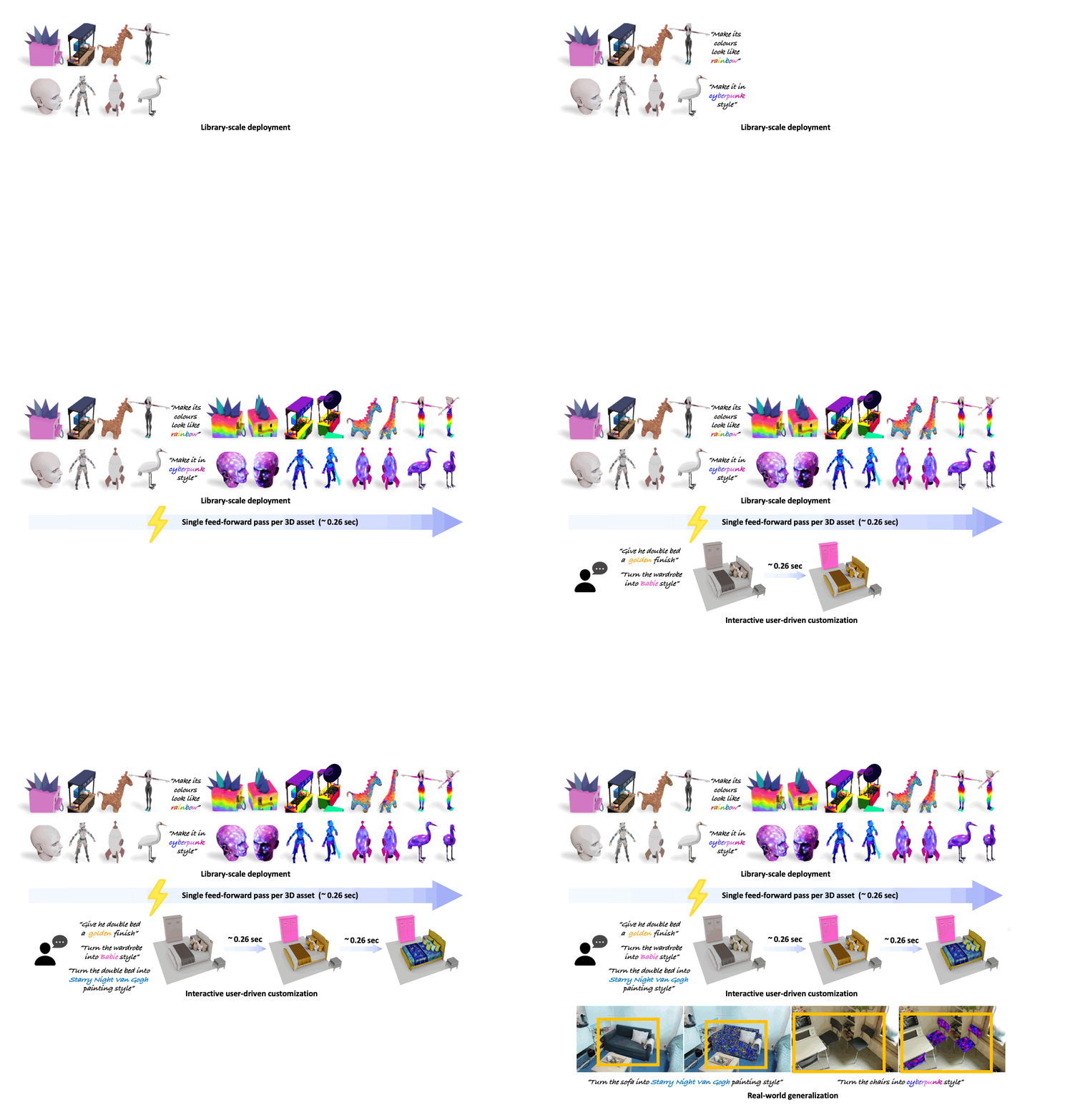
With its ~0.26 second inference time, InStyle supports interactive scene editing ⚡
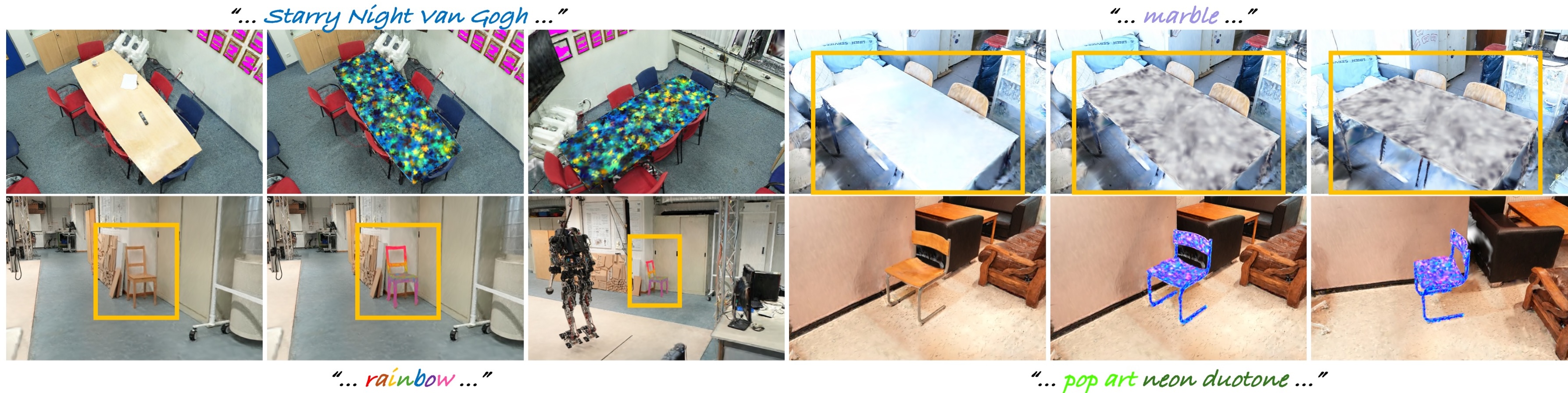
InStyle generalizes to complex real-world 3DGS scenes by extracting target objects, stylizing them, and reinserting them into the original scene despite clutter and capture artifacts.
@article{ocal2025gaussianblender,
  title={GaussianBlender: Instant Stylization of 3D Gaussians with Disentangled Latent Spaces},
  author={Ocal, Melis and Xing, Xiaoyan and Li, Yue and Vien, Ngo Anh and Karaoglu, Sezer and Gevers, Theo},
  journal={arXiv preprint arXiv:2512.03683},
  year={2025}
}